The Bookends of Love
What making Wavelength taught me about economy, collaboration and knowing what to leave unsaid.
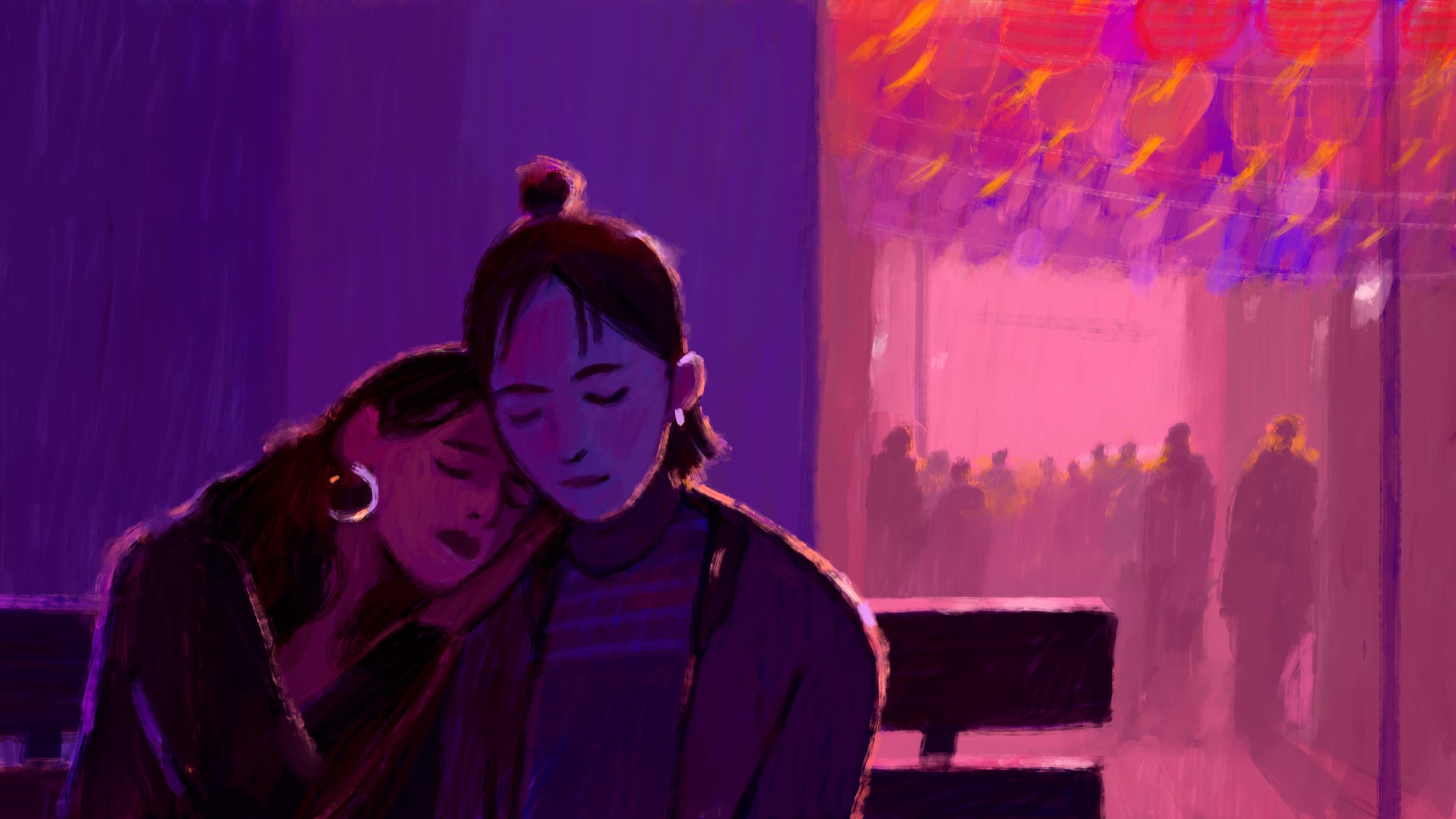
A still from Wavelength (Art: Holly Warburton)
I often return to what it means to be on the same wavelength as someone, and what it feels like when that signal disappears. I'd been imagining something simple on the page: a reflection on the bookends of love, hope and grief, and the fragments in between that we carry with us.
Wavelength became a film almost by accident. We had been developing a commissioned project with animator Holly Warburton when it was cancelled. We'd enjoyed working together, and it seemed a shame for that collaboration simply to stop there. So I went back to the idea I'd been carrying around.
Animation opened it up in a way I hadn't anticipated. Holly’s work is painterly and expressive. Shapes and colours bleed into one another; figures are present without ever feeling fixed. It felt right for a film about memory and connection, things that are intensely real but difficult to hold onto.
The film was made by the team at Toffee Hammer, with Kate Auster leading the production alongside Holly, composer Jack Ledger-Dowse, sound designer Thomas Dalton and Lily Manning, who speaks the words. It runs for only three minutes and forty-two seconds.
There isn't room to explain everything, so every element has to earn its place: an image, a line, a change in colour, a piece of music, a silence. You're trying to create something that can be felt before it is completely understood.
The premise of Wavelength is simple. Two people find each other through the noise. As they become more connected, the colours of their worlds begin to meet. Everything around them recedes. The signal is clear.
Then it isn't.
The film never tells us exactly why. It could be death, distance, time, or simply the way people change. What matters is the transition from presence to absence, and the strange way someone can remain present in our inner world after they are gone.
Perhaps that is why animation suited the story so well. Memory doesn't behave like a photograph. It shifts. Details disappear while apparently insignificant things remain vivid: a colour, a movement, the feeling of standing beside somebody.
Making the film required its own kind of tuning-in. Animation, music, voice and sound each had their own part to play, but each had to respond to what the others were doing. If one element pushed too hard, the film changed. The work was in finding the point at which they seemed to belong to the same thing.
Relationships don't stay perfectly in sync either. They are made from periods of extraordinary closeness and moments of misunderstanding; from finding each other, losing the signal and sometimes finding it again.
Hope at one end. Grief at the other. Between them, the imperfect, fleeting business of trying to hear another person through the noise.