Before the Decision
What making Life Class taught me about attention, uncertainty and the questions we’re not yet ready to ask.
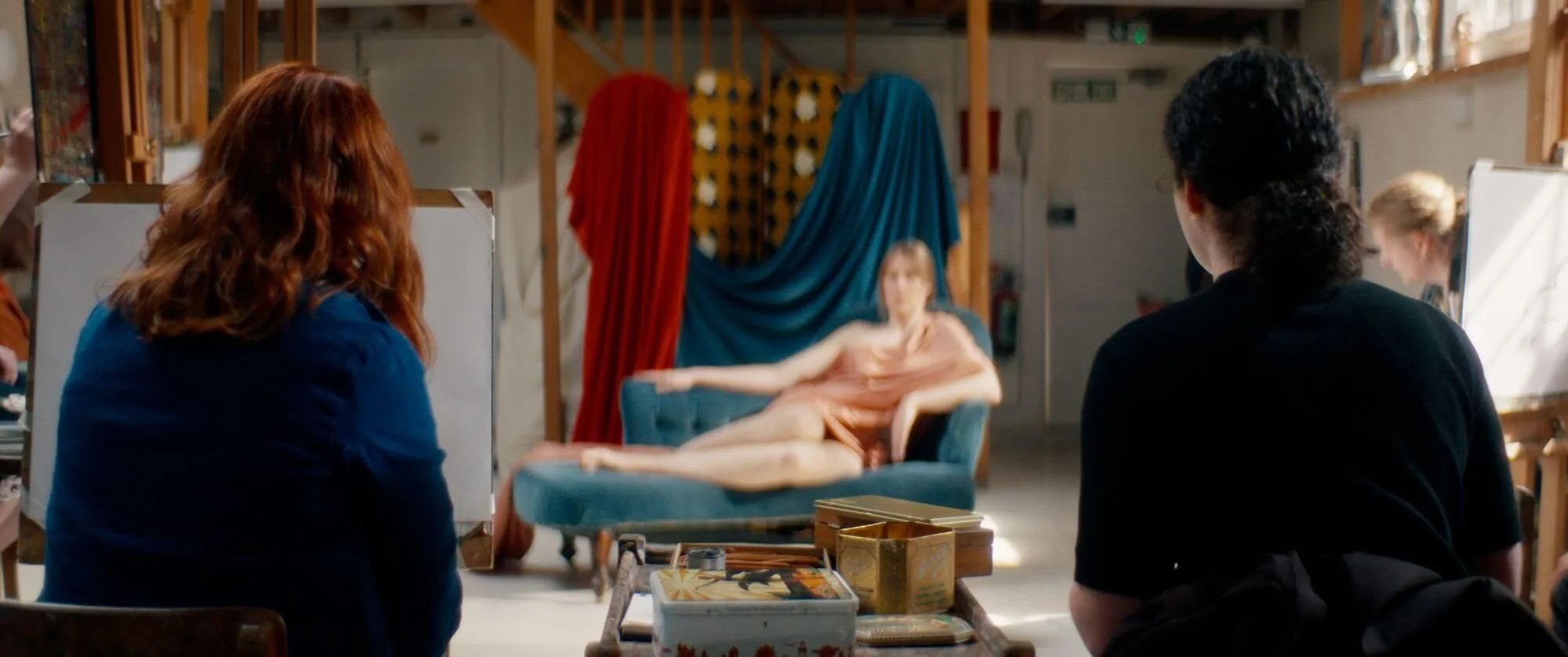
Pooky Quesnel, Molly Vevers and Katie Rivers in Life Class
Eve arrives late. Her friend Celeste notices her engagement ring is gone - hidden, in fact, on a chain around Eve's neck. Around them, the art class continues. They draw. Celeste talks about her late husband. She doesn't try to fix anything.
We shot Life Class over two days in a single location, with Pooky Quesnel as Celeste and Molly Vevers as Eve at the centre of an ensemble cast. The drama takes place in a life-drawing studio.
Stories tend to organise themselves around decisions. Will they leave? Stay? Say the thing they've been avoiding? Change their mind? Life Class is interested in what happens before a decision, when you sense that something has to change but haven't yet found, or perhaps aren't yet willing to ask, the question that might lead you somewhere new.
This is why I chose to set the story in an art class. Drawing from life asks you to set aside what you think or want to see and pay attention to what is actually in front of you. This sustained attention gives you time to notice the things you might otherwise miss. You look, make a mark, look again, adjust. This felt right for a story in which change begins not with a decision, but with seeing something more clearly.
Directing, for me, is partly about creating the conditions for a similar kind of attention. You give the actors enough time and space for something to emerge rather than deciding too quickly what a scene means. You watch what they're doing, where a thought seems to arrive, what happens in the pause before someone speaks. The camera can stay with those moments rather than rushing to explain them. Often, the more closely you look, the less you need to say.
We often summarise films through plot: what happens, what changes, where the story ends. But sometimes what keeps us leaning in isn't wondering what happens next, it's looking more closely at what's already there. A pause that lasts a fraction longer than expected. Someone choosing not to answer. A glance towards another person. The possibility that a character understands something before they're ready to say it.
These moments are difficult to describe in a synopsis because, technically, very little is happening. Yet they can be the moments in which we feel most involved. We're not being told what something means; we're being given enough space to notice it.
I watched E.T. when I was six. I was so overwhelmed by what was happening to him and Elliott that my mum had to take me out of the cinema. I was crying too much for the film to continue around me. I couldn't have explained why it affected me, and I'm not sure explanation would have helped. Some of our strongest responses to stories happen before we have the language for them. Something on screen connects with something in us - a feeling, a fear, a memory, perhaps something we haven't consciously thought about for years. We recognise it before we can name it.
That is part of what I wanted to leave room for in Life Class: not an answer, not even, necessarily, a decision - just the possibility that if we look for long enough, at another person, at ourselves, at life taking place in front of us, we might notice something we hadn't seen before.
Understanding doesn't always come from explanation. Sometimes we recognise something before we can name it.