True Love Will Find You In The End
On making things, disappointment, and staying findable.
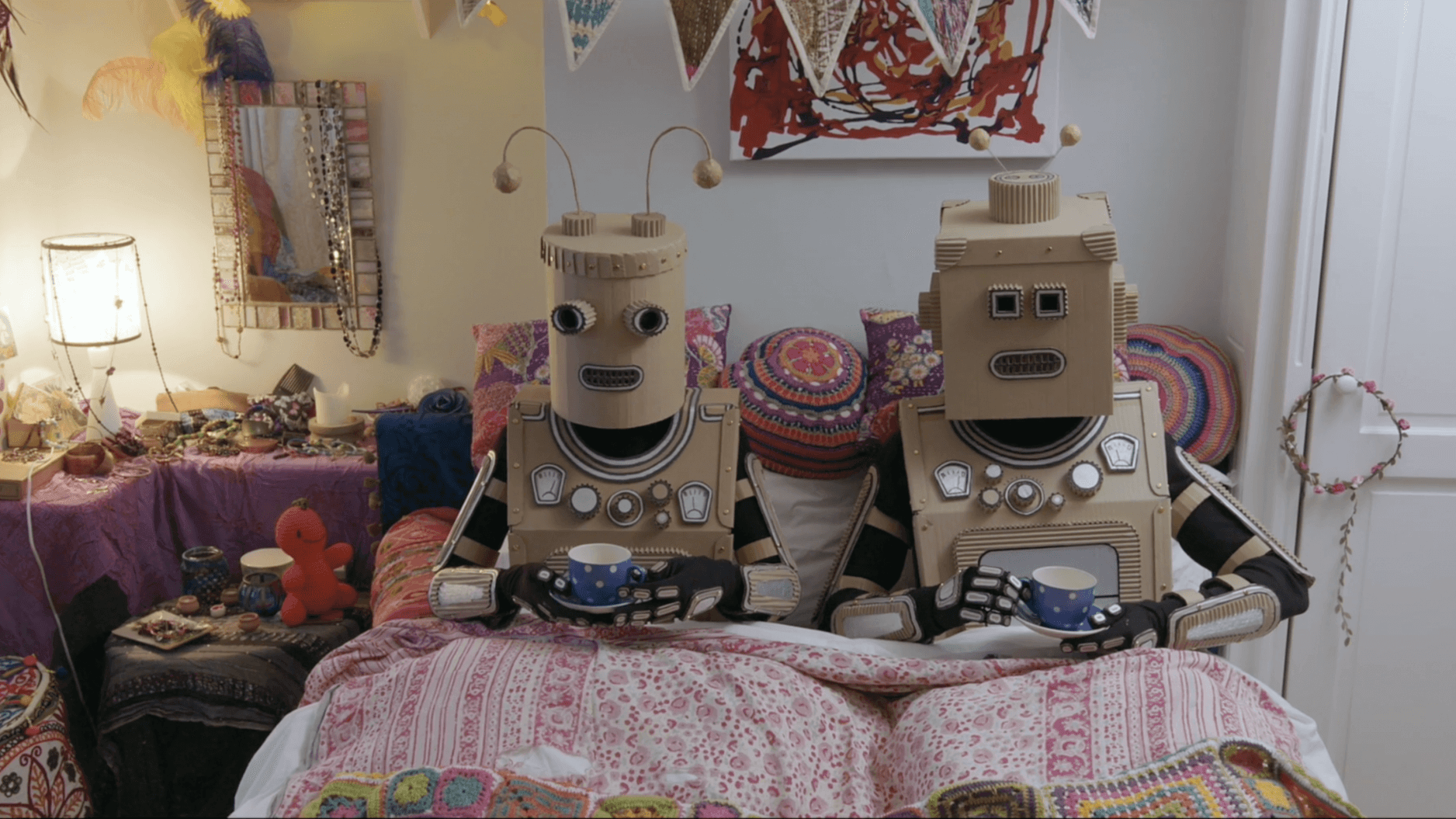
Two cardboard robots in bed drinking tea.
True love will find you in the end. This is a promise with a catch: the possibility of being found depends on being findable.
In the 1980s, Daniel Johnston recorded homemade cassette albums and handed them out in the street. People passed them on, and his audience grew. He had made himself findable. Johnston's life was far more complicated than the lesson I'm drawing from it. He lived with mental illness, and the recognition that came brought difficulties. I don't want to turn his life into a story about persistence being rewarded. What matters is that he kept making things, and he kept giving them away.
A few years ago, I made a feature film for very little money and a lot of love. I wanted to prove I could do it. I have often started frightening things by turning them into practical questions. Can I get a cinema release for a film I've made with £30,000? That was the question I allowed myself to ask. Somewhere in the making, though, the film outgrew the question. Hope kicked in, and after all the effort and all the favours called in, it started to feel like it should pay off in some way. I set out to make a film and ended up hoping it would somehow change my life.
We made it with virtually no crew, finished it and got it into cinemas. That still seems slightly insane to me. I had done exactly what I set out to do. More than that - I’d learned a huge amount. It was still an anticlimax. It didn't do what I'd dreamed it might. No one asked me to make another. It left me feeling deflated and a little foolish. I protected myself by setting a modest goal, then let it grow and punished myself for achieving only the original one.
You make something, send it out into the world and … nothing. Then you have to decide what that nothing means.
I didn't feel I could make another film; everything I'd learned was in danger of going to waste. Except, of course, ambition returned. The people around me encouraged me back to filmmaking and, in 2024, my wife and I, along with the team at Toffee Hammer, made a short film. At first, it felt like going backwards. I had made a feature. I had completed a marathon, however slowly. Why would I now choose to jog around the block?
It wasn't going backwards: I had proved I could run; what I needed was to remember how to walk - to make something for its own sake, not place the weight of expectation on it.
I don't think I dreamed big enough with the feature. There is a part of me I have worked hard to change: the part that limits my ambitions to what I think I deserve. It is a painful habit, and I suspect a fairly common one. You make the dream small enough that failure won't be too humiliating. The joke is that it doesn't really work. You can make the dream smaller, but you can't make yourself care less.
When we talk about making things, there's a temptation to turn disappointment into wisdom and every wrong turn into a useful detour. We like perseverance stories, but mostly when the perseverance works. The rejected manuscript becomes charming when the novel becomes a bestseller. The years of obscurity become evidence of determination once somebody becomes famous. Rags-to-rags stories don't tend to be commissioned.
The feature had its moments, and we had a blast making it. Some people were unkind about it. Some were rude. Well, so what? I'm proud of the film.
I'm proud of the people who made it with me. Whatever failure is mine alone. I had asked the film to prove something for me - about me - that is an odd burden to put on a film.
When I felt most like a failure, a message arrived on Facebook.
"I saw your film. I'm visiting all the locations. Could I also drop by your office and meet you?"
I had never met this person. One person had connected with the film so deeply that they travelled across the country to walk through its world. That doesn't sound like much in an age of follower counts, box office figures and viewing numbers, but it complicated the failure I'd been so sure of. The film hadn't become what I wanted it to be. But it had become something to someone else.
I had made my cassette and left it somewhere somebody could pick it up.