Shouting at the Sea
What making Shouting at the Sea taught me about place, ambiguity and the things we cannot resolve.
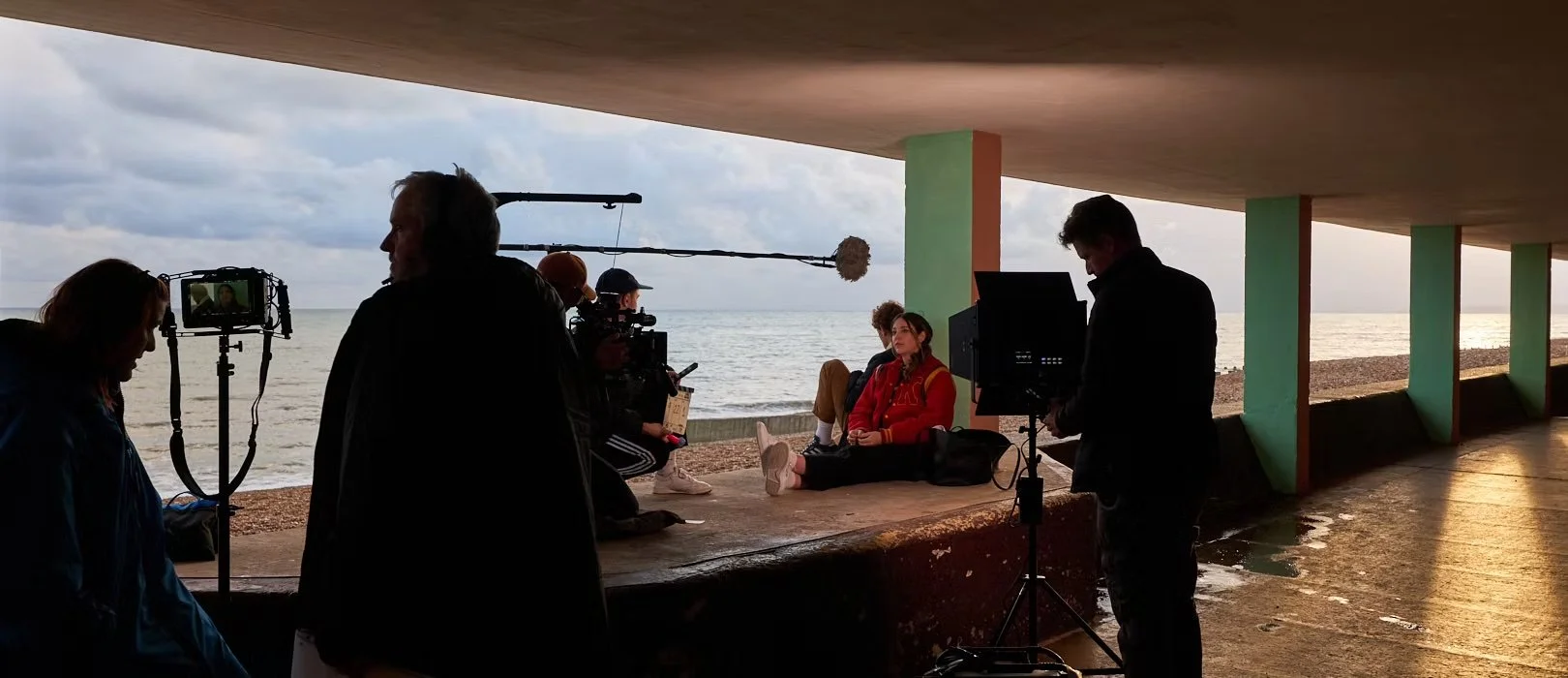
Filming Shouting at the Sea in Bottle Alley, Hastings.
I had the title long before I had anything to say with it: Shouting at the Sea. There was something in the image I kept returning to: the futility of standing at the edge of something enormous and indifferent and demanding an answer from it.
It's easy to think of our problems as fixed, as permanent. The sea has no such agreement. It offers neither reassurance nor judgement. It just keeps moving. Our reunions, regrets and attempts to finally say the right thing exist against that movement. They can feel enormous to us and almost absurdly small beside it.
That tension became the film.
I grew up in Hastings, and I've always been interested in the town outside the tourist season: empty beaches, shuttered amusements, the slightly faded grandeur of buildings that remember a different version of themselves.
In Shouting at the Sea, Joe and Katherine return to places that once belonged to them. The arcade, the pier, the pub. They appear familiar, but neither the places nor the people looking at them are quite the same.
That is one of the strange things about returning somewhere you knew when you were younger. We expect a place to preserve something for us, but memory doesn't work like that. The town carries on without us. What we're really returning to is the version we've been carrying around in our heads.
Joe stayed. Katherine left. Neither choice has given them what they imagined it would. And when they meet again, the question isn't simply whether something remains between them. It's whether the possibility they remember ever really existed in the form they later gave it.
Harry Michell, as Joe, and Maddie Rice, as Katherine, move carefully around one another. Much of what matters between them is never stated directly: a look, a sentence left unfinished, hesitation before a word, a breath between thoughts.
I'm drawn to those places in performance because conversation rarely arrives as a clean exchange of information. We adjust to each other constantly. We begin a sentence and abandon it. We hear more in someone's pause than in the thing they eventually say. When a scene is working, I don't want to feel that I'm watching actors deliver dialogue. I want the slightly uncomfortable feeling that I'm eavesdropping.
The camera has a part to play in that. We shot much of the film handheld and used older lenses to give Hastings a textured, slightly timeless quality. Across the day, the light changes with Joe and Katherine: brighter and more open at first, softer and more uncertain as evening arrives. But I didn't want the camera to tell us what to think about them. It observes. It follows. Sometimes it hangs back. A kind of ghost moving through a conversation it cannot change.
There is a moment near the end of the film when Katherine talks about missing the feeling of possibility - the sense that something might still happen. For me, that became more important than finding a neat answer to what happened between them.
There are things Shouting at the Sea deliberately doesn't explain. We don't get every detail of the past. We don't discover exactly what happens next. Even the sea, which has been there throughout, offers nothing resembling a conclusion.
I gave the sea a voice, but not an answer. Its narration is steady where Joe and Katherine are uncertain, indifferent to the significance they attach to the past. It can observe them, but it cannot resolve anything for them.
Then Joe and Katherine stand at the water's edge and shout.
I think filmmaking constantly tempts us towards explanation - to make motivation clearer, to fill the silence, to make sure the audience understands what we meant. Sometimes that helps. But sometimes explaining something closes it down. Leaving space can allow an audience to bring something of themselves to a film: an old friendship, a relationship that never quite happened, a conversation they wish they'd handled differently.
Once a film is finished, that space no longer belongs entirely to the filmmaker. When you make something, you believe for a while that it is yours. Then it belongs to everyone who made it with you. Eventually it belongs, at least partly, to whoever is watching.
Perhaps that is why I keep returning to the sea. We stand in front of something much larger than ourselves and try to make sense of what happened. We tell the story again. We change the emphasis. We imagine the thing we should have said.
The sea keeps moving.
Closure isn't always an answer, sometimes it is accepting that there isn't one.