The Megaphone and the Mirror
What directing Model Parent taught me about having a vision, letting go of control and making something together.
Bessie Carter and Alistair Petrie in Model Parent
Towards the end of 2025, I directed a short film, Model Parent. It tells the story of a sculptor reunited with her dying father after years of estrangement. Through sculpting his portrait, she forms a new relationship with him and comes to accept him - if not quite forgive.
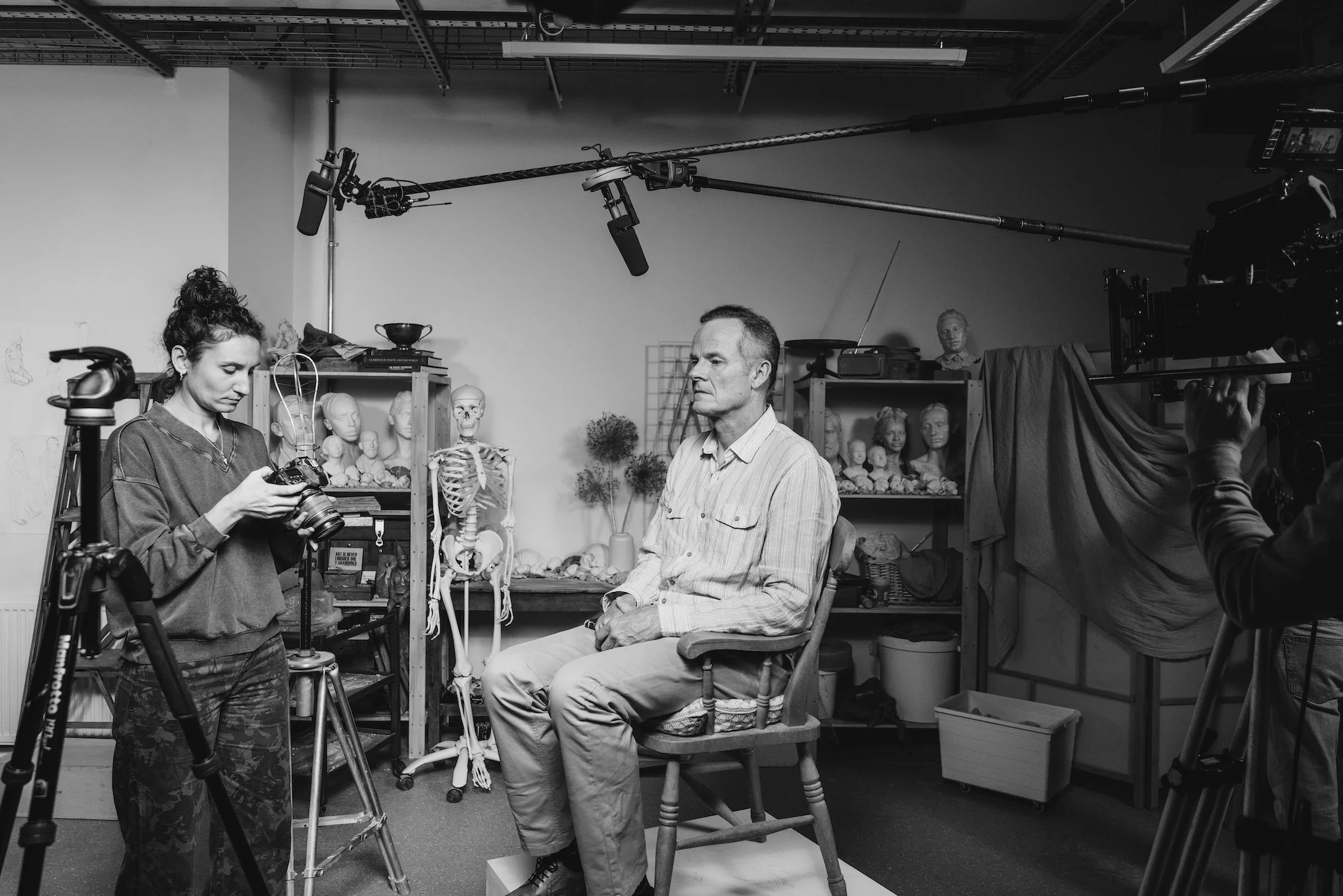
Bessie Carter stands at the sculpting stand. Alistair Petrie sits opposite, carrying a lifetime of history in the smallest shift of his eyes.
An actor breathes in and, instinctively, I breathe in too.
She hesitates before a line and I feel it in my chest, as if the words are gathering somewhere between us. For a few suspended seconds, the room is completely still. The camera team watches patiently. The boom operators hover just out of frame. I am willing it to be “the take” - and at the same time trying not to disturb whatever fragile thing is forming.
From the outside, directing can look like authority. There is a call of “Action.” There is a call of “Cut.”
I always wanted to be a film director. Aged ten or so, I imagined it involved a megaphone. If not literally, then spiritually. I imagined directing was about being seen.
I followed the dream but, as is often the way with dreams, real life turned out to be different. No less vibrant - occasionally more surreal - but different.
What I’ve learned is that, for me at least, the job isn’t to dominate the room. It’s to hold the line. To represent the audience long before they arrive - imagining how each shot will sit beside the next, how performances will cut together, whether we are capturing moments that don’t just tell a story but reveal a world.
Time insists. The work resists. The schedule presses. Light fades. Energy drains.
A director’s task is to keep things moving without sacrificing the scene for the sake of one more setup. To protect restraint when instinct says “more.” To recognise when we have what we need… and to work closely with the Assistant Director to keep everyone on side.
My childhood version of directing imagined control.
The adult version feels closer to containment: holding the emotional temperature of a set steady enough that everyone else can go further. Creating the safety in which extraordinary actors can risk something honest. Giving crew the time and creative freedom to try something new. Standing at the edge of the frame while others step into it.
The Toffee Hammer team built the conditions. Our casting director assembled the constellation. Amelia Rowcroft’s production design filled the studio with her own sculpted works, giving the main character a physical history. She created six “sculpts in progress,” so it felt as though we were watching the portrait come into being in Bessie’s hands. What looks like a single vision is always collaboration.
At their best, leaders invite us into a future more generous and expansive than the present and make it feel reachable. They don’t instruct; they evoke. They help us see who we might become together.
At their worst, they shrink the story. The circle gets smaller. The air changes. What once felt possible begins to feel defended.
Directing is imagination shared. My responsibility on set is to keep the story open. Protect the pause. Hold the version of the scene that is braver than my own insecurity. Trust that if we stay with the moment long enough, something unexpected will emerge.
I forget to say “Cut.”
Because something that only existed in my head now exists between everyone.
Childlikeness isn’t naivety. It’s openness.
Perhaps that’s what the ten-year-old really wanted all along. Not the megaphone. Not the marquee. Just the chance to gather people in a room and say,
“What can we make together?”